
TRANSATLANTIC DIALOGUES
2026



Founded by École de Guerre and The George Washington University, Transatlantic Dialogues for Future Leaders is an annual intercollegiate dialogue series bringing together US and European university students to analyze and discuss important transatlantic topics. During the 2025 Transatlantic Dialogues, graduate students and military officers collaborated to develop and defend strategies for Western liberal democracies to counter disinformation and misinformation, strengthen democratic resilience, and reinforce transatlantic cooperation in the face of evolving information warfare.
For more information, visit the 2024 webpage and the 2025 webpage on this website.
SCHEDULE
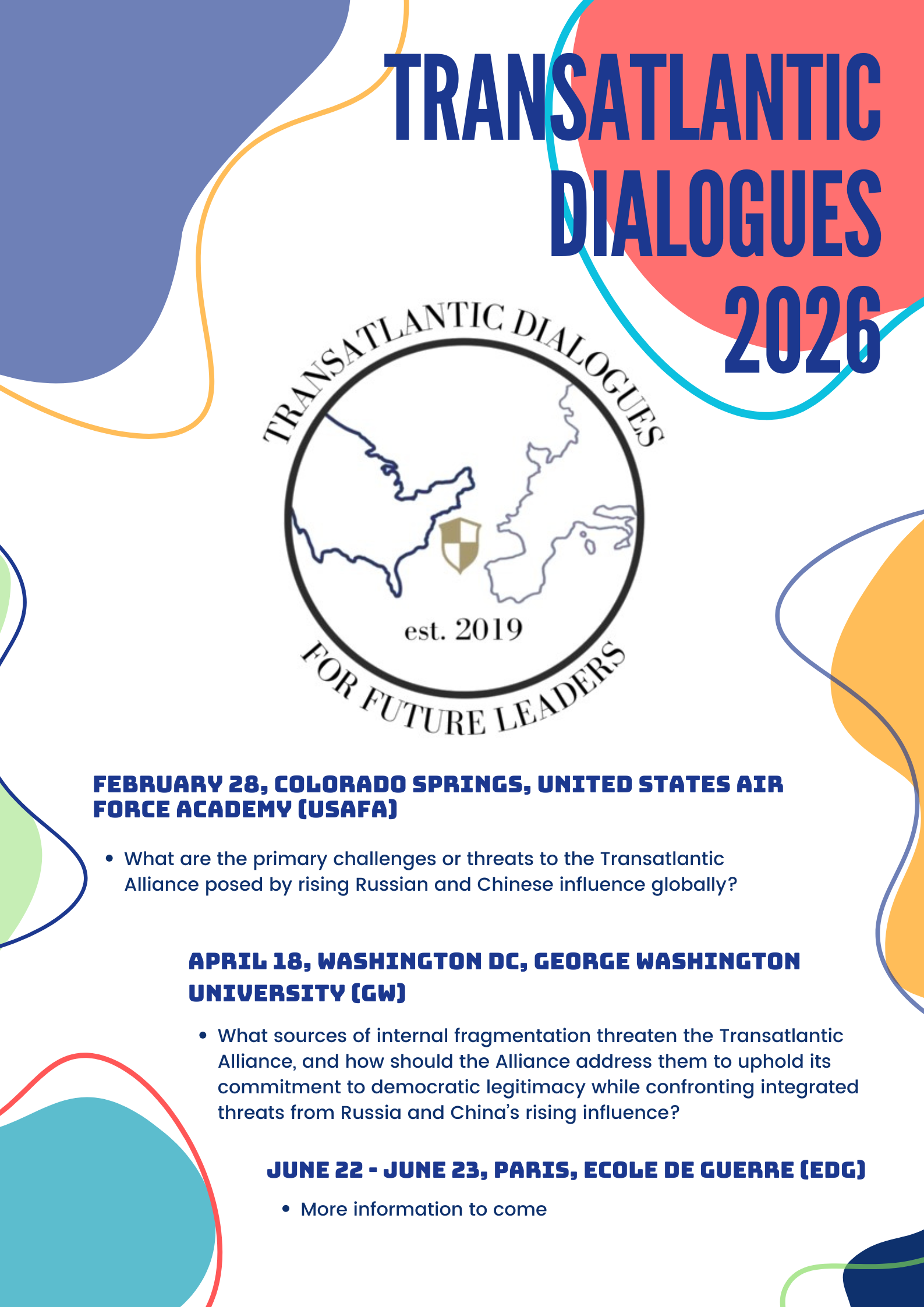
FEBRUARY 28
COLORADO SPRINGS, UNITED STATES AIR FORCE ACADEMY
What are the primary challenges or threats to the Transatlantic Alliance posed by rising Russian and Chinese influence globally?
APRIL 18
GEORGE WASHINGTON UNIVERSITY
JUNE 22 - JUNE 23
PARIS, FRANCE, ÉCOLE DE GUERRE (EDG)
June 22: Transatlantic Dialogues, June 23: cultural activities
More information to come.
What sources of internal fragmentation threaten the Transatlantic Alliance, and how the Alliance should address them to uphold its commitment to democratic legitimacy while confronting integrated threats from Russia and China’s rising influence?
FORMAT
Team A Present & Defend
Team A presents position — 6 minutes 3 Questions, Statements and/or Arguments from Team B. Each question or argument from Team B should be no longer than 30 seconds. Each response from Team A should be no longer than 90 seconds. Teams should use a running clock and cease speaking immediately upon the expiration of their allotted time.
Statement by Team B on Team A’s presentation - 6 minutes
Questions from Judging Panel to Team A - 6 minutes
Concluding statement from Team A - 3 minutes
5 Minute break
TO WATCH THE DEBATE:


FORMAT
Team B Present & Defend
Team B presents position — 6 minutes 3 Questions, Statements and/or Arguments from Team B. Each question or argument from Team A should be no longer than 30 seconds. Each answer from Team B should be no longer than 90 seconds. Teams should use a running clock and cease speaking immediately upon the expiration of their allotted time.
Statement by Team A on Team B’s presentation - 6 minutes
Questions from the Judging Panel to Team B - 6 minutes
Concluding statement from Team B - 3 minutes
The Transatlantic Dialogues use a “collaborative debate” format. Teams are not assigned to defend particular perspectives on a topic. Instead, teams choose their positions and are judged based on the quality of their presentations, arguments, scholarship, and value of their contribution to Transatlantic dialogue around the topic area. In other words, teams ought to seek to present and defend their positions, productively engaging and critiquing their opponents' positions, for the benefit of an audience of Transatlantic security and military stakeholders seeking to determine the best possible policy proposal.
All speech time is “shared time.” This means the team may share the time between their team members and alternate speaking as they see fit. Judges are encouraged, however, to prefer balanced team presentations rather than presentations in which a single team member dominates the allotted speech time.
GENERAL GUIDELINES
During each leg of the Transatlantic Dialogues (Colorado Springs, DC, Paris), each team must present a case responding to the guiding question/topic/motion for that leg only. The debaters DO NOT have to answer all three at once.
The first guiding question "What are the primary challenges or threats to the Transatlantic Alliance posed by rising Russian and Chinese influence globally?", will be used during the Colorado Springs Transatlantic Dialogue on February 28th.
The second guiding question, "What sources of internal fragmentation threaten the Transatlantic Alliance, and how the Alliance should address them to uphold its commitment to democratic legitimacy while confronting integrated threats from Russia and China’s rising influence?", will be used during the Washington DC Transatlantic Dialogue on April 18th.
The third guiding question, will be defined soon and will be used during the Paris Transatlantic Dialogue on June 22th.
6 minutes / 3 questions in the Present-and-Defend format = those questions ARE NOT the guiding questions. These are questions of the other team's choosing that are intended to clarify vague points in the presented case and/or search for gaps in their metaphorical arguments, weak points which can then be highlighted in the response.
Obviously, as the first topic is the vaguest of the three and this might well be the first time that some of the debaters are writing a policy proposal, it can be on the vaguer side. However, it is important to begin making sure that the debaters are developing their ability to address all of the planks in a plan text (mandate, administration, enforcement, funding, spikes) and all of the stock issues (harms, significance, inherency, feasibility, solvency, advantages and disadvantages, alternatives) so that they can further refine those skills as increasingly in-depth and rigorous policy proposals are expected of them in the second and third legs of the Dialogues.
United States Air Force Academy
02/28/2026
The United States Air Force Academy in Colorado Springs is a premier institution dedicated to developing leaders of character for service in the U.S. Air Force and beyond. Combining rigorous academics with military training and athletic development, the Academy provides a comprehensive education that prepares cadets for the demands of leadership in a rapidly evolving global environment. As one of the nation’s most prestigious service academies, it emphasizes discipline, integrity, and innovation while offering cutting-edge programs in science, engineering, and the humanities. Cadets gain hands-on experience through research, flight training, and leadership opportunities from their first year. With a strong commitment to excellence and service, the Air Force Academy equips graduates with the skills and values needed to succeed in both military and civilian careers.
For the first tournament in the 2026 series, to be held at the United States Air Force Academy (USAFA), in Colorado Springs, students will present and defend policy proposals addressing the critical question: "What are the primary challenges or threats to the Transatlantic Alliance posed by rising Russian and Chinese influence globally?"

George Washington University
04/18/2026
The George Washington University in Washington, D.C. is a distinguished institution committed to academic excellence and the development of leaders prepared to make an impact in a global society. Blending rigorous academics with real-world perspective, the university offers a dynamic education that equips students with the skills needed to navigate complex professional environments. Known for its strong programs in fields such as political science, international affairs, business, and public health, it fosters innovation, critical thinking, and civic engagement. With a focus on leadership and service, George Washington University prepares graduates to excel in diverse careers and contribute meaningfully to society.
For the second tournament in the 2026 series, students will present and defend policy proposals on the topic: “What sources of internal fragmentation threaten the Transatlantic Alliance, and how should the Alliance address them to uphold its commitment to democratic legitimacy while confronting integrated threats from Russia and China’s rising influence?”
The debate format will follow this structure:
10 min Constructive Team A
· Team B: 2 questions (2:00 total)
· Team C: 2 questions (2:00 total)
· 4 min Judge Questioning
10 min Constructive Team B
· Team A: 2 questions (2:00 total)
· Team C: 2 questions (2:00 total)
· 4 min Judge Questioning
10 min Constructive Team C
· Team A: 2 questions (2:00 total)
· Team B: 2 questions (2:00 total)
· 4 min Judge Questioning
3 min shared prep time
6 min Reply Team A
6 min Reply Team B
6 min Reply Team C
École de Guerre
06/22/2026
École de Guerre in Paris trains military leaders for senior command roles, blending strategic theory with practical experience. Its curriculum focuses on military strategy, leadership, and modern warfare, preparing officers to navigate complex global security challenges. Students engage in rigorous academic study, simulations, and direct exposure to high-level decision-makers. With its unique position within France’s defense structure, the École de Guerre equips graduates to lead with vision and impact military strategy and international cooperation.
For the third and final tournament in the 2025 series, to be held at École de Guerre in Paris, students will present and defend policy proposals on a topic that will be defined later.
Event Outline:
Monday June 22nd: Transatlantic Dialogues.
Tuesday June 23rd: Cultural activities
More to come…
